
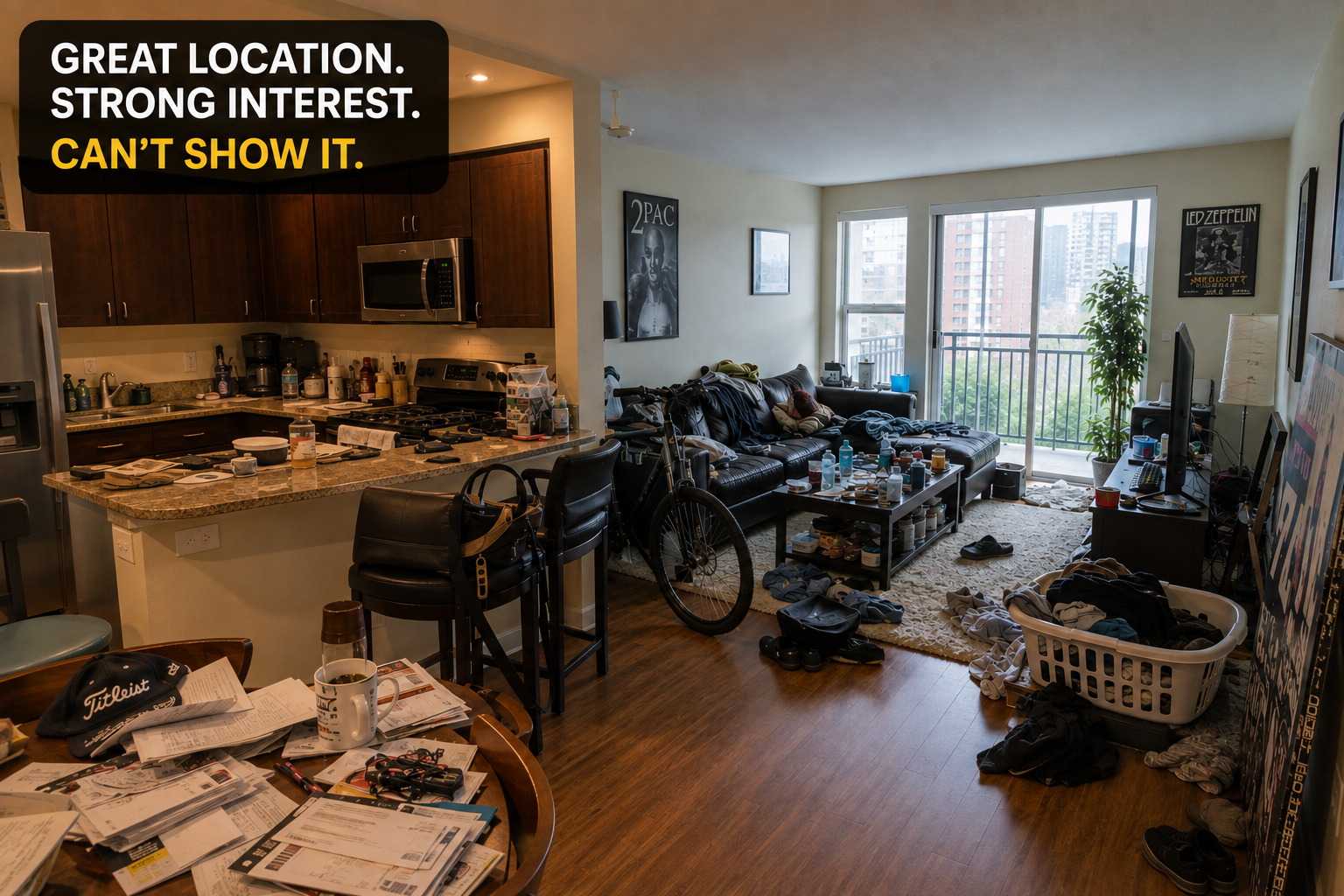
Can you sell an Arlington condo with a tenant still living in it?
Yes. Nothing in Virginia law stops you from listing and selling a tenant-occupied condo, and the sale itself doesn’t end the lease — the buyer steps into your position as landlord and inherits the remaining term. What changes is everything around the sale: your tenant controls day-to-day access for showings, Virginia requires you to hand over the security deposit at settlement, and a signed lease running past closing quietly removes most owner-occupant buyers from your pool. The decision isn’t legal. It’s whether the shrunken buyer pool costs you more than waiting out the lease would.
You bought a one-bedroom in Ballston or Crystal City a few years ago, moved out, and rented it. Now you want to sell — but your tenant has eight months left on the lease.
Every person you ask gives you a different answer. Your neighbor says you have to wait. A property manager says just sell it, investors buy tenanted units all day. Someone on Reddit says you can give 30 days’ notice.
They’re each partly right and partly wrong, and the difference costs real money in Arlington’s condo market. Here’s the actual picture.
The Lease Goes With the Unit, Not With You
Start here, because almost every wrong assumption about tenant-occupied sales traces back to this one point.
Selling the condo does not terminate your tenant’s lease. A lease is a contract that attaches to the property. When the deed records, the buyer becomes the landlord and takes on the remaining term at the existing rent, on the existing terms, with the existing end date. Your tenant does not have to move because you sold.
Virginia is explicit about the money side of that handoff. Under Va. Code § 55.1-1213, the current owner has to transfer any security deposits — plus any accrued interest — to the new owner at the time of transfer. If you use a property manager, you have to give that manager written notice before settlement so the funds move in time, and the manager then has to notify the tenant in writing that the deposit went with the sale.
That statute has teeth in the other direction, too: whoever holds the landlord’s interest when the tenancy ends is on the hook for returning the deposit, regardless of what any side agreement says. So this isn’t a detail your title company can improvise on closing day. It belongs in the contract and on the settlement statement from the start.
Practically, a tenant-occupied Arlington closing has four extra moving parts: an assignment of the lease, the deposit credit on the settlement statement, a written notice to the tenant telling them where to send rent, and a proration of the current month’s rent between you and the buyer. None of that is hard. All of it needs to be agreed to before you’re a week from settlement.
Showings Are the Part That Actually Costs You
This is where tenant-occupied sales go sideways in a market like ours.
Virginia does give you access rights. Under Va. Code § 55.1-1229, a tenant “shall not unreasonably withhold consent” to let the landlord exhibit the unit to prospective purchasers. And if your rental agreement specifically provides for it, a tenant who declines to allow showings without reasonable justification can be liable to you for damages, costs, and reasonable attorney fees.
Read that carefully, though, because the leverage is thinner than it sounds:
- The remedy is a lawsuit after the fact — it does nothing for you on a Saturday when a buyer wants to see the unit at 2 p.m.
- The attorney-fee provision only applies if your rental agreement contains that language. Plenty of leases don’t.
- You still have to give notice of intent to enter and enter only at reasonable times. You can’t run a lockbox like a vacant unit.
So what you’re really negotiating is cooperation, not compliance. A tenant who’s annoyed shows the unit with dishes in the sink, the blinds closed, and the dog barking. A tenant who’s been treated well keeps it clean and leaves for showings.
Two things I tell every owner in this spot. First, tell the tenant before the sign goes up, not after they see it on Zillow — nothing poisons cooperation faster than finding out from a stranger. Second, put something on the table: a rent credit for the listing period, a cleaning service every other week, a flat payment at closing for a clean handoff. A few hundred dollars buys you photography that doesn’t look like a rental and showings that don’t get declined. On a $500,000 unit, that math is not close.
The Quiet Problem: Your Buyer Pool Shrinks
Here’s the part nobody warns sellers about, and it’s the one that shows up in the final price.
Most people buying a condo in Arlington are buying it to live in. If your lease runs to next June, they can’t. And it’s not just preference — the financing follows the occupancy. FHA-insured and VA-guaranteed loans are for principal residences; a VA borrower has to certify that they intend to personally occupy the property as their home, per VA’s eligibility rules. A buyer who can’t take possession can’t use those programs on your unit at all. In a county with the Pentagon in it, that is not a small slice of the market.
What’s left is investors, second-home buyers using conventional financing, and cash. That’s a smaller, more price-sensitive group, and they underwrite your unit on the rent it produces rather than on how much they love the kitchen.
Timing matters here too. NVAR and George Mason University’s Center for Regional Analysis, in their 2026 mid-year regional forecast, project Arlington condo inventory to finish the year up about 28% over 2025, with condo prices up roughly 2.2% and unit sales up 3.2%. Supply is climbing much faster than either prices or sales. When there are more units competing, voluntarily removing the largest segment of buyers from yours is a bigger decision than it was three years ago — a dynamic I’ve covered before in what rising condo inventory means for Arlington sellers.
One piece of genuinely good news for investor-heavy buildings. In Lender Letter LL-2026-03, issued March 18, 2026, Fannie Mae retired the 50% investment-property concentration limit for established projects reviewed under the Full Review option on investor loans. For years, a building where more than half the units were rentals could knock a conventional investor loan sideways. That specific barrier is gone.
Don’t over-read it, though. The same letter retired the Limited Review process entirely as of August 3, 2026 — four days ago — so every established condo project now goes through Full Review or a Waiver of Project Review. Full Review means a real look at the association’s budget and reserves, and Fannie Mae is tightening there: lenders can no longer use the baseline reserve-funding method, and the replacement reserve requirement rises from 10% to 15% of the annual budgeted income assessment for applications dated on or after January 4, 2027. Your building’s financials are getting more scrutiny, not less, even as the investor cap goes away. If you haven’t looked at where your association stands, that’s worth doing before you list — it’s the same ground I cover in whether your Arlington condo building is Fannie Mae warrantable.
Your Three Real Options
Every tenant-occupied listing I’ve handled comes down to one of these.
1. Sell it occupied and market it as an investment. You keep collecting rent through settlement, you don’t have a vacancy gap, and you avoid turnover costs. You accept a narrower buyer pool and pricing that leans on the rent roll. This works best when the lease is at or above market rent, the tenant is solid, and the lease has under a year to run — an investor will pay for a unit that’s already producing.
2. Wait for the lease to end and sell vacant. You get the full buyer pool, clean photography, an easy lockbox, and the freedom to paint and update. You give up months of momentum and eat some carrying cost. If the lease ends in three months, this is usually the right call. If it ends in eleven, it’s a much harder trade.
3. Negotiate an early exit in writing. Va. Code § 55.1-1253 says the landlord and tenant may agree in writing to an early termination of a rental agreement. That’s a real, common path — it usually costs you a month or two of rent plus moving help, and it’s frequently cheaper than the price gap between a vacant listing and an occupied one. If your tenant is already month-to-month, the same statute lets either side terminate with at least 30 days’ written notice before the next rent due date, unless your rental agreement sets a different period.
One warning on option 3, and it’s the reason I insist everything be in writing. If you promise vacant possession at settlement and your tenant doesn’t leave, that’s your problem, not the buyer’s. Section 55.1-1253 gives you a remedy for a holdover tenant — possession, actual damages, attorney fees, and, if your rental agreement includes it, a liquidated damages penalty capped at 150% of the per diem monthly rent for each day past the termination date. But a lawsuit doesn’t get you to the settlement table on time. Never contract for vacant possession until the tenant is actually out or you have a signed, dated surrender agreement in hand.
A Few Arlington-Specific Details
Your condo association’s documents matter here. Some Arlington buildings cap the number of units that can be rented, and if your building is at its cap, a buyer who plans to keep your tenant may not be able to. Others require the association to be notified of a new lease or a new owner. All of it surfaces in the Virginia resale certificate, which you’re required to provide — and the buyer’s review period after receiving that package is a negotiable contract term that defaults to three days if the blank is left empty. I walk through that whole process in what Arlington sellers must know about the Virginia condo resale certificate.
Also worth noting: your tenant is a tenant, not an obstacle, and Virginia’s Fair Housing Law applies to how they’re treated throughout the listing. Keep the process professional and documented. If a situation feels complicated, that’s an attorney question, not an internet question.
And plan on the ordinary costs of selling on top of all this — commissions, the Virginia Grantor’s Tax, and settlement fees don’t change because there’s a tenant.
Frequently Asked Questions
Does selling my Arlington condo automatically end my tenant’s lease?
No. The lease attaches to the property, not to you. When the deed transfers, the buyer becomes the landlord and inherits the remaining term, rent, and end date. Your tenant has the right to stay through the end of the lease unless they agree in writing to leave early.
Who gets the security deposit when the condo sells?
The buyer. Under Va. Code § 55.1-1213, the current owner must transfer any security deposits and accrued interest to the new owner at the time of transfer, and whoever holds the landlord’s interest when the tenancy ends is responsible for returning it to the tenant. It shows up as a credit on the settlement statement, and it needs to be in the contract, not sorted out at the closing table.
Can my tenant refuse to let buyers see the unit?
Not unreasonably. Va. Code § 55.1-1229 says a tenant shall not unreasonably withhold consent to exhibit the unit to prospective purchasers, and if your rental agreement provides for it, an unjustified refusal can expose the tenant to damages, costs, and attorney fees. But that’s an after-the-fact remedy — in practice you need cooperation, and it’s usually worth paying for it.
Will I get less for a tenant-occupied Arlington condo?
Often, yes — not because the unit is worth less, but because a lease running past closing removes owner-occupant buyers, including anyone using FHA or VA financing, from your pool. What’s left prices the unit on its rent. How big that gap is depends on your building, your lease term, and your rent, which is exactly the kind of thing a real building-level analysis answers.
How much notice does a month-to-month tenant get in Virginia?
At least 30 days’ written notice before the next rent due date, unless the rental agreement specifies a different period, per Va. Code § 55.1-1253. A fixed-term lease is different — it runs to its end date and can only be shortened by written agreement between you and the tenant.
There’s no single right answer to whether you sell occupied or wait. It’s an arithmetic problem: the price gap between an investor sale and an owner-occupant sale, weighed against the rent you’d give up and what an early lease termination would cost. In some buildings that gap is small enough that selling occupied is clearly the better move. In others it isn’t close.
If you want to know what your unit is actually worth — not a Zestimate, but a real building-level analysis that accounts for your lease, your building’s rental cap, and what’s actually sold in your building — that’s what I do. Start your selling plan at ArlingtonCondo.com/sell.
About Rick Bosl
Rick Bosl is Arlington’s condo specialist — with 23+ years of experience, 325+ transactions closed, and $165M+ in sales volume focused almost exclusively on Arlington’s condo market. As the founder of ArlingtonCondo.com and Managing Broker at KW Metro Center, Rick knows every building, every floor plan, and what buyers in each neighborhood are willing to pay. He holds the CRS and GRI designations and brings an electrical engineering degree and MBA to every transaction — because condo decisions should be driven by data, not guesswork. Licensed in Virginia, Maryland, and DC.